This blog is written by the mission secretary and it is from her perspective. In fact, most of the blogs are written by her. (Those written by someone else will be noted.) So if you find an error or would like to change what is said about you or your missionary, if you have any inspiring stories or thoughts, just email me at japannagoya.mission@ldschurch.org. I'll do my best to make the blog better and more accurate.
In the mission, you don’t live from day to day, week to week, or month to month. You live and mark time from transfer to transfer. When you ask a missionary how long he has been on his mission, he tells you how many transfers he has been through.
So much has to happen at transfer time, and it has to be orchestrated. Every six weeks is transfers. While there is much we do that is not related to transfer week, I think one could say that in the mission, you have transfer week, then you spend two weeks doing the necessary work to recover from transfers, then you spend the next three weeks preparing for the next transfer.
President Baird starts preparing for transfers just days after the last one. I have heard him refer to D&C 8 and 9 with regard to how he prepares. He studies it out by learning about these missionaries. He reads a two-page information sheet they send in about themselves, talks with their bishop or stake president, reads their missionary application form. And he knows the missionaries he has very well. He talks with them regularly, reads their weekly letters, gets feedback from their companions, and he loves them all so much. He takes a recommendation to the Lord. He says he has an opinion about whom that new missionary should be placed with, but he knows the Lord knows where he should be. The Lord is very clear with President Baird on placing missionaries at transfer time. He clearly feels Him directing the mission. He has experienced having a missionary with some problem or another and feeling he needed to be moved. He has moved him again and again to different companions and locations, and somehow he has always bounced back to the original place. So President Baird has tried to move his companion to a different spot, and he, too, has bounced back. It's as if there was a rubber band on each missionary. The Lord knows where each missionary needs to be!
Transfer week is an interesting, exhilarating, inspiring, fast paced, and exhausting multi-faceted production. One of the sweet things is to have the entire office staff, along with President and Sister Baird, just sit together in the big office room and talk about all the cool things that happened, after it is all over. We are all usually tired and moving slowly, and it’s just satisfying to sit together and review and bask in the feelings and the joy of it all. Each time we do that, we marvel at the little things that made it so special, and are always struck with the conviction that many of those things couldn’t have happened without Heavenly Father’s hand in it. It is humbling to realize the power behind this work.
Day 1
On Monday here, it is still Sunday in Utah. We are doing a final review of many details. Missionaries throughout the mission know it is transfer week, and they know they need to stay in their apartment until they receive a phone call from one of the two AP’s (Assistants to the President). AP’s start early and call every missionary companionship to tell them if and/or where they will be moving for the next six weeks, and if they were chosen to train one of the new incoming missionaries. It’s really fun and exciting to listen to the AP’s tell each missionary about his new assignment.
Departing Missionaries: At 12:30, all the missionaries who are ending their missions and returning home arrive at the mission home. They shipped their luggage by train a few days earlier and it is waiting for them at the airport. They have a meeting with President and Sister Baird, get some great advice for their future lives, and meet with Elder Barney to turn in any unused church funds from their mission, making sure they have enough for food on way home. By the time all of this is done, Sister Baird has a great dinner ready for them. It is entertaining to watch the food disappear. Did they really eat THAT much? But it’s gone! They love Sister Baird’s cooking, they aren’t nervous like new missionaries are, and they really go down on whatever she serves. Her lasagna and brownies are fabulous. Following the meal, they have a testimony meeting. Then they all go out for a final evening of missionary work, getting back in time to be in bed by 10:30. The middle floor of the mission home has about 7 bedrooms with two beds in each. That usually handles all the missionaries.
Tuesday: Missionaries going home are up by 6 a.m. sharp Tuesday morning for a quick continental breakfast. President and Sister Baird drive them to the airport and wave goodbye to the non-Japanese missionaries until they are out of sight. Then President and Sister Baird drive the Japanese missionaries to the Nagoya Eki and say goodbye to them. Most of them can get home via train, but a few of them do fly. The Bairds get back to the mission home by about10, and use their brief respite to make sure their talks are ready for later.
At noon on Tuesday, all the missionaries who are transferring to another location must be at the Nagoya Eki, or train station. There is a huge golden clock there, and that is where they meet, tell their old companions goodbye and head off with a new companion to their new area. If they are trainers, they come to the mission office. In most cases in the mission, the rule is that you should never be without a companion. This process at the central train station works well for all of them.
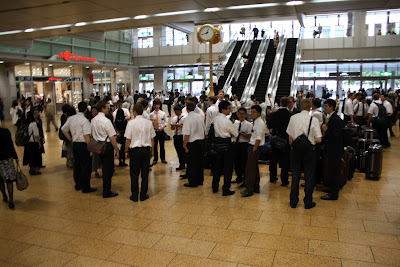 |
What a great sight.
Talk about "Hope of Israel!" |
 |
| New trainers in training. |
At about 1:00, the trainers arrive here and attend meetings with President Baird where he instructs them about training new missionaries. He also does a great job of finding out special things about each of the incoming missionaries. He takes the time to individually tell each trainer about this new missionary he or she will be helping to learn the ropes. He installs a high regard and even a love in these young men/women for the new person they are about to meet. The new trainers leave around 4 and go to nearby missionary apartments to spend the night, but it’s not party time. They split up with the other missionaries and go out and share the Gospel. And right then, President and Sister Baird, along with the rest of us at the office, get into cars and head out to the airport.
New Missionaries are trained at the Mission Training Center for 10 weeks. They make great progress on learning the language and they are taught how to share the Gospel. They also begin living by the rules of the mission field, which are quite strict, but they are wise and for the success and safety of each missionary. Those missionaries coming to Japan get up at about 4 a.m. on their appointed day, usually a Monday morning, ride on a bus from Provo to the Salt Lake City airport, and then fly to Detroit, where they board a plane that comes directly to Nagoya. (Nagoya is Toyota headquarters, so that is why there are direct fights between here and Detroit.)
 |
While waiting at the airport, time is not wasted.
Our two AP's, Elders Kervinen and Hollister talk to one man,
while behind them President Baird is talking to another.
They are "dendo-ing," sharing the Gospel. |
 |
| Elder Benham with President Baird |
 |
Elder Shimizu with President Baird.
Sister Yamada in back. |
Our new missionaries arrive about 4:30, are welcomed by the mission president and office staff,
walk their luggage to the shipping department at the airport and their bags are labeled with where each missionary will be serving and shipped to that apartment.
 |
I love this photo--13 luggage carts being
pushed by 13 handsome missionaries. People notice. |
 |
| Does this look like Japan, or what! |
Group pictures are taken. These missionaries know each other well by now and will always be special to each other.
 |
| Hoiza! Hoiza! Hoiza! |
They then catch a train from the airport to within walking distance of our mission home. On the way, they are challenged to talk with all the people they can in Japanese (their first real experience as missionaries, and for the foreign missionaries, their first real experience to use their newly acquired language skills with a native) and tell them something about the Church or perhaps give them a Book of Mormon. They arrive at the mission home around 7:30 or 8. We show them where they will be staying, visit with them a little, feed them a wonderful lasagna dinner that they are usually too tired to each much of, and have them go to bed. We do dishes, cleaning up and get things ready for morning.
 |
| This is the lasagna dinner--looks good and tastes even better. |
Day 3
 |
| THIS is the waffle breakfast. |
Wednesday: The newbys are up by 7 a.m. the next morning, which is easy for them because their body time tells them it’s much later. They write a little note for Sister Baird to put in her scrapbook and they are given a little advice from her about some things “Japanese” that they need to be aware of. For instance, if you don’t regularly air out your futon, it will grow mildew. Then we feed them a waffle/egg/fruit breakfast that is out of this world. Sister Baird makes the best waffles ever, and she has a syrup for the waffles that is to die for. It
isn’t maple syrup; it
IS the best syrup I’ve ever tasted. They have a picture taken individually, and another with President and Sister Baird.
 |
| Sister Yamada writing her note. |
 |
| One of our new transfer groups, first day in the mission. |
Then the training begins. I get to talk with them about the mail system, how to write letters to the president (which they are supposed to do once each week), gather their passports for copying, and a few other things. Elder Barney then has his turn, and he talks to them about all things money-related. There is much to learn. Sister Baird talks to them, and her focus is on keeping them healthy. She talks about food, exercise and other important things.
 |
| Sister Baird, teaching. |
Then we have what is a highlight for me. To explain let’s go back to their arrival at the airport: We were all waiting when these missionaries came walking out with their luggage. President Baird and Sister Baird greeted each new missionary individually and gave them a big hug. They talked a little and then we had them stand in a couple of different spots for photos as a group, and they did the HOIZA shout (meaning Hope of Israel, Zion’s Army). Then after they walked down to the shipping place with all their luggage on 13 different luggage carts (I love the fact that luggage carts are free to use in Japan) and dropped them off, and piled all their backpacks with their overnight stuff onto two other carts, they left to catch the train. All of this was recorded with photos and video, and much of it was recorded without them noticing.
Some interactions on the train are also captured on their way home. Our mission recorder then stays up nearly all night and puts together the most wonderful, inspiring video, with these new missionaries as stars. This is the highlight that we get to view after breakfast. The office staff is usually in tears, and I think the missionaries are too. I know I was when we watched video of ourselves arriving in Japan. It was such a surprise and so well done. This DVD will be sent to the parents of each new missionary the week following arrival. Parents love it.

But back to instructions after breakfast: Each of the Assistants to the President take time to talk to the new missionaries about the culture of the mission. This includes what is expected of them as missionaries and information about cultural differences they need to be aware of.
The Recorder describes his role with referrals and how to order supplies. The Commissarian talks about taking care of apartments and bicycle safety. Then the President ends with a talk to them. He gets them excited and anxious to be about the work they have come to do.
 |
Elders Burnett, Olsen, and Sanderson
getting to know the President. |
 |
| Sister Baird doing her favorite thing, giving gifts. |
 |
| Elder Jones meeting Elder Ikeda for the first time. |
At 11:00, one missionary at a time comes up two stories to the top floor of the mission home where he has a brief interview with President Baird in his office. This is when the president gives the new missionary information about his new companion/trainer. Finally, he or she walks out of the president’s office, and meets his first companion/trainer. This is a part that I also love. They greet each other with a big hug. Photos are taken again. It is a happy celebration. I am amazed when I see who President Baird has chosen as the first companion and trainer for each new missionary. Because I get to read information letters about each new missionary, I know something about them. I am also getting to know the missionaries who are here and who will be training these new missionaries. I am astounded by the perfection that is usually evident in the matchup. President Baird says it isn’t him who chooses who goes together; it is the Lord. Often he will have someone completely different in mind, and he will get an impression that it should be someone else. He always follows those impressions.
 |
| Elder James with his new companion, Elder Clark. |
The missionaries then meet with Elder Barney to get some money to start out with and some debit cards to use on their mission. He gives them other instructions. Then they have to fill out some forms and order some things, get their passports back from me, and just relish all being together in this office talking with each other. The missionaries love opportunities to get together, to see old companions they have served with, to pass along news and exciting events.
To be asked to train a new missionary is a huge responsibility because you will set the tone of that missionary’s mission and success. Usually, it is the very best missionaries who are asked to train. These young men, along with the new missionaries, are full of life and happiness. They are in white shirts and ties, looking sharp and clean and handsome. Most of them are so darn cute, and just get cuter as you get to know them better. They have chosen to stop their schooling, stop whatever other plans they may have had, risk giving up prestigious appointments to the Air Force Academy or several other top schools, and really put their lives on hold, for two years. They come and live in small apartments, learn how to get along with people they didn’t choose to live with who might be very different from them, be in each night by 9 to 9:30, go to bed by 10:30, get up at 6 and exercise, study scriptures for an hour, clean up the apartment, and spend the day reaching out to people who they don’t know and who usually don’t want to talk with a stranger who can barely speak their language. I watch them all standing in my office, talking and happy and good, and I can hardly keep from crying. It just touches my heart so deeply. At this point they are too young to realize how deeply this mission will change their lives, make them in to men and women who are honest, kind, willing to help others, dependable, able to manage money, work hard, and make good decisions. They don’t realize it, but I do. I know what it did to my children and I’ve seen it in numerous young single adults we worked with for six years. I just want to shout for joy!
Last of all, they go to the church, which is next door to the mission office and receive more instruction and information from President and Sister Baird and the Assistants, and they have a testimony meeting. They share their testimonies with each other. President and Sister Baird get more personal with them, telling them about their own experiences that led to their being where they are now, giving them insight into who they are and what is important to them, and share their testimonies. Finally, President Baird issues a commitment to each missionary, one by one in front of all the others, to read from the Book of Mormon each day--not just during his or her mission, but for the rest of their life, no matter what. And they are sent off, each with a new companion, to have some lunch and get on the train to their first assigned city.
 |
| Off to have lunch and catch a train to their first area. |
It’s usually close to 3:00 by then, and we are finished with the part that has to be done within a timeline. There is still much to do, but it can be done at a more moderate pace.
Whew! And I have only described three days. But they are usually our most intense.


